
Funeral Cost Breakdown: How Much Does A Funeral Cost in 2026?
Updated on Mar 31, 2026 • 9 min read
According to the National Funeral Directors Association’s (NFDA) most recent funeral cost assessment, the median funeral cost with a casket and burial is $8,300, and it continues to rise yearly. So, how can you avoid paying a high funeral bill and leave your family with peace instead of another expense?
Thankfully, you have a few options to get ahead of burial costs, such as prepaying for your funeral or relying on government assistance programs. However, those options come with risks and hidden fees. If you’re looking for a flexible, customizable option, final expense insurance is an outstanding way to address your funeral bill before you pass.
With final expense insurance, you can cover your projected funeral costs, give your loved ones an extra financial boost, or provide an inheritance. You have total control over your coverage and can tailor it to fit your needs. If you’re interested in learning more about final expense insurance, Final Expense Benefits is the expert, and we are here to help.
Call us at (866) 786-0725, Monday through Friday, 9 a.m. to 5 p.m. ET. Check our free online quoting tool for life insurance options and pricing estimates.

How Much Does a Funeral Cost?
When planning for end-of-life expenses, it’s important to consider the cost differences between a traditional funeral and cremation. A full-service funeral, including a casket, embalming, burial plot, and ceremony, can cost thousands of dollars, often exceeding $7,000. In contrast, cremation is generally cheaper than a traditional funeral because it eliminates costs associated with embalming, caskets, burial plots, and headstones. While both options come with various additions that can impact the final price, cremation generally provides a more budget-friendly alternative for those looking to reduce funeral expenses.
Here’s how funerals and cremations breakdown:
Funeral Cost vs Cremation Cost
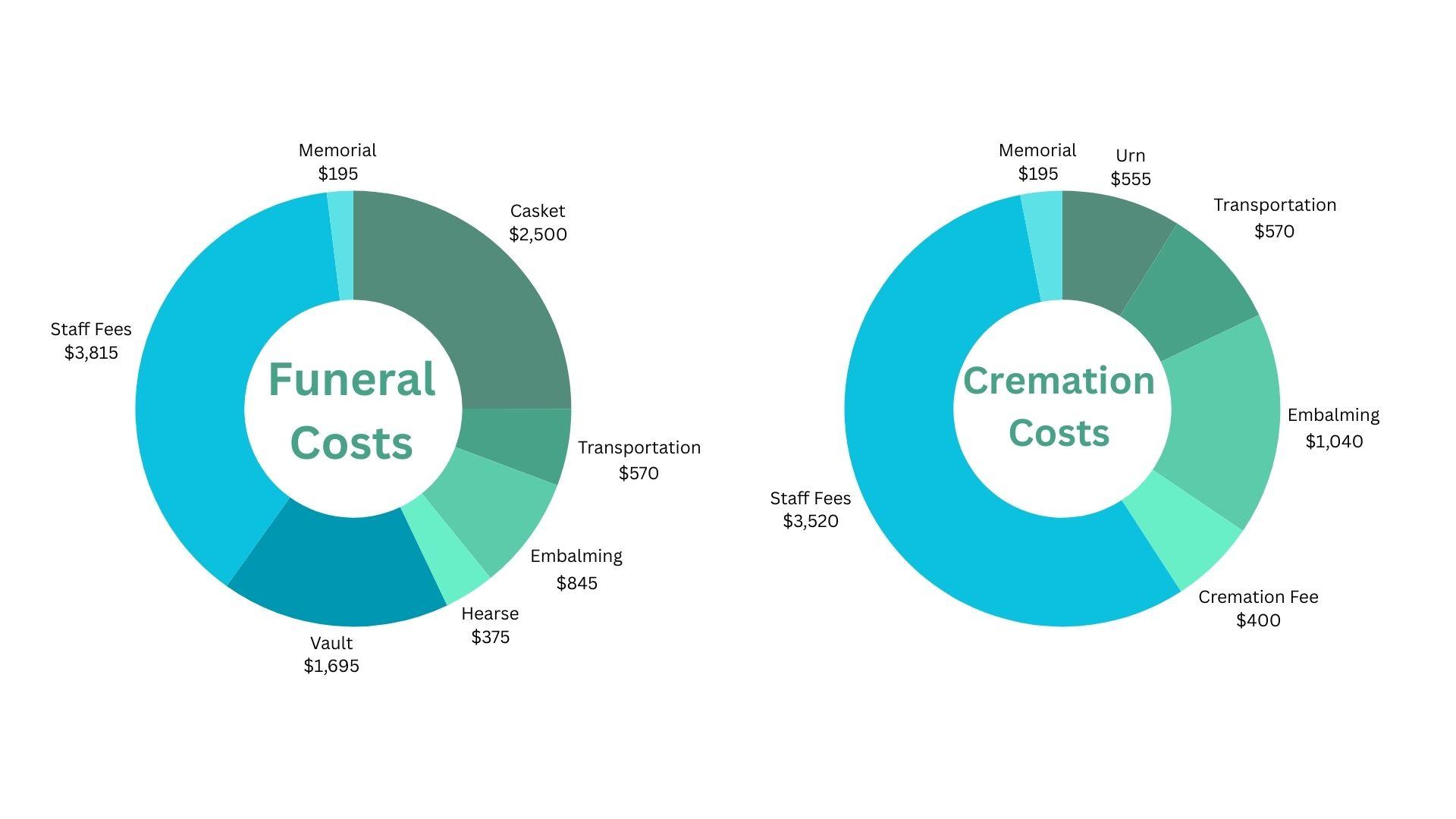
Funeral prices vary by location and how elaborate you’d like your funeral service to be.
Looking into the future, the National Funeral Directors Association (NFDA) states that traditional burials have been increasing in price at a rate of 6% every year, and they don’t show any sign of decline, as cremation has seen an increase of about 8% every year. Despite the difference between a burial and a cremation, a cremation won’t overtake the price of a traditional burial anytime soon. Vault prices, one of the more expensive aspects of a burial, continue to increase yearly.
Funeral Cost vs Cremation Cost in My State
Costs fluctuate based on real estate prices, labor fees, and state regulations.
Here’s an overview of funeral costs in select states in 2026:
| Traditional Funeral | Cremation | |
|---|---|---|
|
New England (CT, ME, MA, NH, RI, VT)
|
$8.985
|
$7,023
|
|
Middle Atlantic (NJ, NY, PA) |
$8,573 |
$6,498 |
|
South Atlantic (DE, FL, GA, MD, NC, SC, WV, VA) |
$8,023 |
$6,103 |
|
East South Central (AL, KY, MS, TN) |
$7,615 |
$5,858 |
|
West South Central (AR, LA, OK, TX) |
$7,912 |
$5,890 |
|
East North Central (IL, IN, MI, OH, WI) |
$8,280 |
$6,120 |
|
West North Central (IA, MN, KS, MO, ND, SD, NE) |
$8,755 |
$6,713 |
|
Mountain (AZ, CO, ID, MT, NV, NM, UT, WY) |
$7,390 |
$5,505 |
|
Pacific (AK, CA, HI, OR, WA) |
$7,835 |
$5,812 |
Funeral prices vary by location and what services you would like to include.
Wondering what it’s going to cost you in 2026? Our funeral cost calculator reflects an estimate based on your region and the changes that we expect to see in the market. However, you should always check with an insurance agent to find out exactly how much a funeral will cost in your region.
How Much Does A Funeral Cost in My State?
The World Population Review has averaged funeral costs and end-of-life expenses by state because each state’s funeral expenses differ. They state that Hawaii has the most expensive funeral and end-of-life expenses, while Mississippi has the least.
Here’s how much each state’s funeral costs and how much final expense insurance coverage you might need in 2026:
| States (A-M) | Funeral Cost Average | End of Life Cost Average | Total Cost |
|---|---|---|---|
|
Alabama |
$6,924 |
$12,376 |
$19,197 |
|
Alaska |
$9,913 |
$17,720 |
$27,633 |
|
Arizona |
$7,845 |
$14,023 |
$21,868 |
|
Arkansas |
$6,800 |
$12,154 |
$18,954 |
|
California |
$10,727 |
$19,173 |
$29,900 |
|
Colorado |
$8,357 |
$14,356 |
$22,668 |
|
Connecticut |
$9,689 |
$17,318 |
$27,007 |
|
Delaware |
$8,357 |
$14,937 |
$23,294 |
|
Florida |
$7,667 |
$13,705 |
$21,372 |
|
Georgia |
$6,924 |
$12,376 |
$19,300 |
|
Hawaii |
$15,203 |
$27,175 |
$42,378 |
|
Idaho |
$7,288 |
$13,027 |
$20,314 |
|
Indiana |
$7,001 |
$12,514 |
$19,516 |
|
Iowa |
$7,133 |
$12,750 |
$19,833 |
|
Kansas |
$6,808 |
$12,168 |
$18,976 |
|
Kentucky |
$7,265 |
$12,985 |
$20,250 |
|
Louisiana |
$7,234 |
$12,930 |
$20,163 |
|
Maine |
$8,999 |
$16,086 |
$25,085 |
|
Maryland |
$9,921 |
$17,733 |
$27,654 |
|
Massachusetts |
$10,270 |
$18,356 |
$28,626 |
|
Michigan |
$7,040 |
$12,584 |
$19,624 |
|
Minnesota |
$7,838 |
$14,010 |
$21,847 |
|
Mississippi |
$6,568 |
$11,739 |
$18,307 |
|
Missouri |
$6,885 |
$12,307 |
$19,192 |
|
Montana |
$7,652 |
$13,667 |
$21,329 |
These funeral costs are based on averages for basic services and may vary.
| States (N-W) | Funeral Cost Average | End of Life Cost Average | Total Cost |
|---|---|---|---|
|
Nebraksa |
$7,172 |
$12,819 |
$19,991 |
|
Nevada |
$8,434 |
$15,075 |
$23,509 |
|
New Hampshire |
$8,380 |
$14,979 |
$23,358 |
|
New Jersey |
$9,154 |
$16,363 |
$25,517 |
|
New Mexico |
$6,939 |
$12,404 |
$19,343 |
|
New York |
$10,355 |
$18,509 |
$28,863 |
|
North Carolina |
$7,404 |
$13,234 |
$20,638 |
|
North Dakota |
$7,512 |
$13,426 |
$20,941 |
|
Ohio |
$7,195 |
$12,861 |
$20,055 |
|
Oklahoma |
$6,722 |
$12,016 |
$18,739 |
|
Oregon |
$10,424 |
$18,633 |
$29,058 |
|
Pennsylvania |
$7,892 |
$14,106 |
$21,998 |
|
Rhode Island |
$9,247 |
$16,529 |
$25,776 |
|
South Carolina |
$7,748 |
$13,428 |
20,941 |
|
South Dakota |
$6,808 |
$12,168 |
$18,976 |
|
Tennessee |
$6,986 |
$12,487 |
$19,068 |
|
Texas |
$7,148 |
$12,777 |
$19,926 |
|
Utah |
$7,536 |
$13,470 |
$21,005 |
|
Vermont |
$8,984 |
$16,058 |
$25,042 |
|
Virginia |
$7,869 |
$14,065 |
$21,934 |
|
Washington |
$8,620 |
$14,065 |
$24,028 |
|
West Virginia |
$7,133 |
$12,750 |
$19,883 |
|
Wisconsin |
$7,485 |
$13,331 |
$20,789 |
|
Wyoming |
$7,389 |
$13,207 |
$20,595 |
These funeral costs are based on averages for basic services and may vary.
Wondering what it’s going to cost you in 2026? Our funeral cost calculator reflects an estimate based on your region and the changes that we expect to see in the market. However, you should always check with an insurance agent to find out exactly how much a funeral will cost in your region.
Traditional Funeral Cost Breakdown
According to the National Funeral Directors Association (NFDA), the median cost for a funeral with a casket and burial is $8,300. However, this data is based on their most recent funeral cost assessment in 2023.
The NFDA assesses funeral costs to have risen yearly by 6%. Accounting for a 6% funeral cost increase since 2023, our 2026 funeral cost estimate is $10,595 – for a basic service.

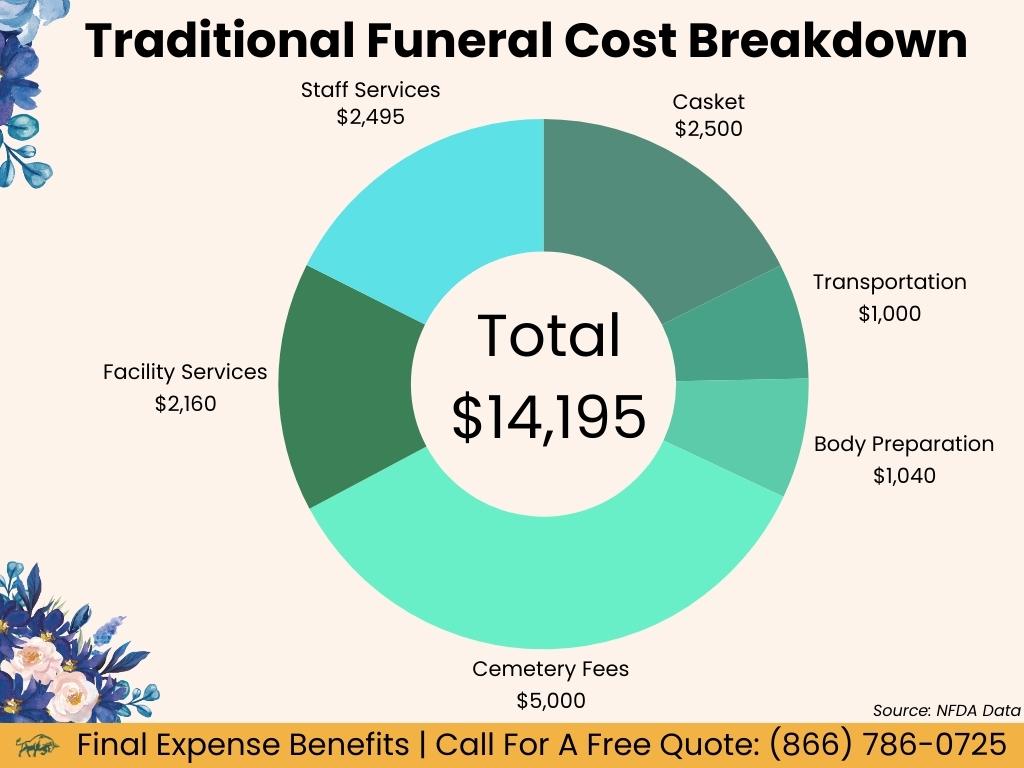
Their $8,300 funeral cost estimate doesn’t account for the cost of a vault, which is often required by cemeteries and costs nearly $1,700 on average, and includes only a basic casket cost. A more decorative casket or service beyond basic essentials can dramatically increase this funeral cost estimate.
1
Casket Cost
Burial caskets are easily the most expensive single traditional funeral cost. Casket costs range from below $100 for cardboard ones often used for cremations to tens of thousands of dollars for fancy wooden coffins.
A more reasonable median casket cost is around $2,500 for a simple metal burial casket, per NFDA estimates. That’s for a very basic casket and casket costs can run much higher, especially if you want a wooden casket. For coffins suitable for traditional viewings, the average wooden casket costs around $5,000.
Burial casket costs tend to be high because they are meant to remain indefinitely intact. Caskets are made out of tough materials to withstand weather and ground pressure. Quality craftsmanship comes at a high cost, and you likely need to pay if you want a traditional funeral.
2
Funeral Home Service Fees
Funeral home fees make up another major portion of traditional funeral costs. Either you or your family will need to pay a long list of funeral home fees – and there’s not much you can do about them. Most funeral homes almost always require these services, adding to your burial costs:
| Fee | Cost |
|---|---|
|
Services fee (body preparation, staff pay, etc.) |
$2,495 |
|
Embalming |
$845 |
|
Other body preparation (makeup, clothing, etc.) |
$295 |
|
Viewing facilities / staff |
$475 |
|
Ceremony facilities / staff |
$550
|
|
Service Fee Total |
$4,660 |
These pricing estimates are sourced from the NFDA.
If price increases continue at their projected rate, expect funeral facility fees closer to $5,000 in 2026. Costs vary depending on the funeral home, desired services, location, the service’s scale, and more.
However, you’re generally paying for quality. Funeral home services are specialized work requiring training and expertise. What’s important is to balance out your desired budget with what you and your loved ones want in a funeral.
3
Transportation
Transportation is an easily overlooked funeral cost. This includes body transport into the funeral home, hearse transit from funeral facilities to the cemetery, and attendee transportation.
Funeral transportation costs vary depending on what you need and how far your funeral home is from your grave site.
You may wish for funeral attendees to be transported by a bus from the ceremony to the burial, or for them to follow your hearse with a police escort.
These additional services add another $1,000 or more to your burial costs. However, the cost varies heavily depending on what’s necessary for your funeral.
4
Burial Plot, Headstone, and Cemetery Fees
Another major burial cost is the plot and headstone. Burial plot costs vary, but they average around $2,500. Remember this is one of the most variable funeral costs and your burial plot could cost much more, depending on location.
Headstones range in cost and quality. You can find headstones for as low as about $300, but if you are going through the effort of holding a traditional burial, you’ll probably want a high-quality headstone that lasts. For higher-end headstones, expect to pay upwards of $2,000 or even up to $10,000 for decorative, customized grave markers.
Some cemeteries may charge additional fees for burial services, such as a vault, interment (which is when the casket is lowered into the grave plot), and grounds fees. A vault is a metal sleeve that holds dirt back when the casket is lowered. Cemeteries often require vaults. The NFDA estimates average vault fees to be about $1,700.
You should budget at least $5,000 for combined burial costs with prices varying depending on your desired service, location, and more.
Based on these funeral cost breakdown estimates, a traditional funeral with a burial and viewing could cost closer to $15,000 or more depending on your and your loved ones’ desired services.
Factors That Affect Funeral Costs
Funeral costs can vary heavily depending on a few factors out of your control, but you have some ways to spend less.
1
Funeral Costs by Location
Funeral costs often vary by state. Rural states like Alaska or small states with little room to devote to expansive cemeteries like Hawaii cost the most. States with a lower cost of living like Kansas and Mississippi offering the least expensive burial costs.

2
Type of Funeral
A traditional burial with a viewing is the priciest funeral type. If you choose a different kind of funeral, costs can drop dramatically.
According to the NFDA, cremation is the most popular funeral type in the United States. Cost is certainly a factor: the average cremation cost is closer to $6,300.
Other types of funerals are becoming more popular too. Direct burial and direct cremation (burial or cremation services without a ceremony) cost significantly less than their traditional counterparts.
Green burials, also known as eco-burials, are another economical alternative. A tree pod burial costs around $4,000, less than a third of the cost of a traditional funeral.
However, these are all just alternatives. We can only list projected price estimates; how you go out is up to you and your loved ones. If you want a traditional funeral with a ceremony, it’s a beautiful way to be remembered. Just prepare for the costs.
3
FTC Funeral Rule
In 1984, the Federal Trade Commission (FTC) introduced a rule to regulate how funeral service providers charge for funerals.
The FTC Funeral Rule requires funeral service providers to provide standardized pricing lists, itemized receipts, and detailed funeral cost breakdowns.

The FTC funeral rule was designed to create transparency in the funeral process and to protect grieving families from being taken advantage of by funeral service providers.
4
Following Funeral Cost Saving Best Practices
It’s important to know your rights granted by the FTC Funeral Rule, but you and your loved ones can do more to control funeral prices and ensure you’re not overcharged. Here are some of our suggestions on how best to save on funeral costs:
- Request the funeral facility’s general pricing list
- Shop around and find at least three different funeral homes to compare prices
- Don’t share your exact budget to maintain negotiating power
- Don’t buy your casket or urn from the funeral home
- Consider not holding a viewing service
- Try a direct funeral
- Host the memorial at home
- Look into green burials
- Hold the service at the grave site rather than a funeral home
Alternative Funeral Options
While a traditional burial and funeral can cost up to $10,000, there are alternative funerals that can lower the initial cost of your funeral. Some options are even free! No matter what kind of funeral you choose, Final Expense Insurance can help ease the burden or fully pay for your funeral.
Call one of our agents at (866) 786-0725 from 9 a.m. to 5 p.m. on a weekday to receive a quote.

Here are the different burial and cremation methods that could save you money on your funeral:
Green Burials
With rising funeral costs in the USA, there are plenty of sustainable options to consider when trying to save on costs. A green burial, also known as an eco-burial, offers a more environmentally conscious way to lay a loved one to rest. Examples of this include tree pod burials to water cremation services. It generally requires fewer resources and steps than a traditional burial, making it both an eco-friendly and cost-effective option.
In a green burial, the body is preserved through refrigeration instead of embalming. Rather than being placed in a traditional wood or metal casket, it is buried in a biodegradable shroud or casket that naturally decomposes over time. It also eliminates traditional funeral expenses, with some programs covering transportation and cremation costs.
Burial at Sea
A burial at sea is a process that involves blending cremated remains with a specialized concrete mixture, shaping it into a reef-like form, and positioning it underwater. This acts as an artificial coral reef, providing a habitat for marine life on the ocean floor.
The cost of a memorial reef burial will differ depending on the company and package you select. The initial cost you pay will be for the cremation and the reef memorial creation is an additional cost. A direct cremation without a service or viewing costs between $2,000 and $5,000. If you would like to have a cremation with a service and a viewing before the memorial reef is created, the cost will range from $4,000 to $7,000.
Military Service
Veterans are entitled to a free burial and grave marker if they choose to be buried in a national cemetery. However, your family must cover any additions you want to your funeral, which can add up to around $3,000 or more. If you’re a military member, you must consider additional fees for the rifle salute ceremony, flag ceremony, a “taps” performance, and more.
Generally, the funeral home you work with will let you know how much everything will cost and coordinate the ceremonies you request. Consider getting burial insurance if you’re unprepared to pay for those services.
Call us at (866) 786-0725 or use our free quoting tool to compare policies and find the best option for you and your needs.
Viewing or Memorial Service
The choice to have a funeral is not mandatory; some choose to only host a viewing or memorial service at a funeral home, church, or other venue. Depending on location and services provided, viewing or memorial services cost around $500 to $2,500 in 2025.
How to Cover Funeral Costs
You can cover funeral costs by dipping into retirement savings or seeking government support. However, none are as reliable at covering up-front funeral costs like a strong final expense insurance policy.
1
Funeral Government Assistance
The federal government and some states offer limited funeral assistance programs, though none offer enough of a payout to cover an entire funeral. Some states provide funeral assistance to low-income families but coverage is limited.
The Social Security Administration offers a lump sum death benefit of $255.

This may cover a few flower arrangements but it comes nowhere near covering a meaningful portion of traditional burial costs.
Veterans Affairs pays about $2,000 to cover veteran funeral costs for veterans. This won’t fully cover burial costs but can help.
2
Final Expense Insurance
A major challenge in meeting funeral costs is a lack of control. You have little control over how much funeral homes charge for your funeral and even less over government assistance.
But you can assist in your family’s financial future with final expense insurance.
Final expense insurance is a type of whole life insurance specialized in covering end-of-life expenses like funerals. You can choose your policy’s payout, which typically range from $5,000 to $50,000.
Getting a final expense insurance policy that can cover funeral costs and more doesn’t have to be difficult or expensive. A $10,000 policy can cost less than $30 per month.
Plus, final expense insurance grows in cash value over time and can grant an even larger payout. Most plans offer quick approval thanks to speedy underwriting turnaround and relaxed application requirements designed with seniors saving to cover funeral costs in mind. You often don’t need to take a medical exam to qualify for a quality policy and some policies guarantee approval.
3
Donating Your Body to Science
Donating your body to science is a meaningful way to contribute to medical advancements, education, and research. This option eliminates funeral costs, supports scientific discovery, and provides a lasting legacy.
However, it also comes with certain drawbacks, such as eligibility requirements and the long waiting period for the ashes.

This may cover a few flower arrangements but it comes nowhere near covering a meaningful portion of traditional burial costs.
Veterans Affairs pays about $2,000 to cover veteran funeral costs for veterans. This won’t fully cover burial costs but can help.
4
Funeral Pre-Planning
Funeral pre-planning allows individuals to make arrangements in advance, ensuring their final wishes are honored while reducing stress for loved ones. This proactive approach can also lock in costs, preventing financial burdens. However, it may require a significant financial commitment and could have limitations such as the funeral home closing, losing out on all that was paid up front.
Before committing to a pre-planned funeral, it’s essential to review all financial details, ensure flexibility in the contract, and communicate your wishes with your family.
How Final Expense Insurance Covers Funeral Costs
In most cases, beneficiaries are entitled to death benefit payouts immediately following the policyholder’s death. This is a major reason why final expense insurance policies are great for covering up-front bills like burial costs.
You can qualify for final expense insurance even if you smoke or have a pre-existing medical condition, such as:

Some plans require a mandatory two-year waiting period or pay death benefits with delays. Final Expense Benefits is here to help you get the best available coverage at the price you want. We can guide you through the application process and help you find a great policy, often without a waiting period.
How Much Does Final Expense Insurance Cost?
A major benefit to final expense insurance is the cost. You can cover a large portion of funeral costs with a policy with a $10,000 benefit – which you could get for less than a dollar a day. Here are some example monthly prices for a $10,000 policy from our top providers for a non-smoking applicant with no preexisting health issues:
| Company |
Male 50y/o |
Female 50y/o |
Male 60y/o |
Female 60y/o |
Male 70y/o |
Female 70y/o |
|---|---|---|---|---|---|---|
|
$34 |
$27 |
$50 |
$40 |
$70 |
$56 |
|
|
$31 |
$26 |
$43 |
$35 |
$71 |
$53 |
|
|
$31 |
$24 |
$44 |
$33 |
$75 |
$53 |
|
|
$34 |
$29 |
$45 |
$35 |
$79 |
$59 |
|
|
$33 |
$26 |
$48 |
$36 |
$82 |
$58 |
These figures are estimates only, based on a $10,000 final expense insurance policy with no applicant pre-existing conditions.
If you’re interested in these or any of our other life insurance options, call us at (866) 786-0725 to learn more. Be sure to check our free online quoting tool for personalized pricing estimates.
Conclusion
A traditional funeral with a viewing, service, and burial costs a lot – often nearly $15,000. It’s a beautiful way for loved ones to commemorate a life, but it comes with major expenses. That’s where final expense insurance comes in.
You can fully cover funeral costs ahead of time with a final expense insurance policy, giving you and your family major peace of mind. Final Expense Benefits is here to help you understand your final expense insurance options and to help you get the policy you need at a great price.
Call us Monday through Friday, 9 a.m. to 5 p.m. ET, at (866) 786-0725 to learn more about final expense insurance. Check our free online quoting tool for a personalized price estimate.
FAQ
What is the average cost of a funeral in 2026?
Average funeral costs with a viewing and a burial are nearly $15,000, even for basic funerals with a simple casket and service. Get ahead of these costs with a final expense insurance policy.
Why are funerals so expensive?
Traditional funerals are expensive mainly because of the skills needed to facilitate them. Preparing bodies for viewings and cemetery plots for burials requires specialized training. Casket costs are high due to the craftsmanship required.
Do funeral homes charge to hold a body?
They often do, though costs depend on the funeral home. Many may include body storage fees in overall funeral costs, but extended storage periods may require higher fees.
Is cremation cheaper than burial?
Yes, in general, cremations are cheaper than funerals. This is because there isn’t as many expenses that are required in cremation.
Does Social Security pay for funeral expenses?
Yes, Social Security does give a payout for funerals. However, the maximum you can receive is $255, which barely makes a dent in your funeral expenses.
What is the FTC Funeral Rule?
The FTC Funeral Rule protects consumers by requiring all funeral services be clearly dictated to you so you know exactly what you’re paying for.
How much does a funeral cost without insurance?
Without insurance, a funeral can easily cost you over $10,000. Depending on what you would like, it can cost you more than $15,000.
What is the cheapest way to have a funeral?
The cheapest way to have a funeral is to have a full-body donation and private ceremony. However, you need to qualify for a full-body donation first, and getting ashes back is unpredictable.
That’s why we suggest getting burial insurance instead.